Company
Company
Private Equity Connect 2026: Quido among the partners
In Milan on 15 July, more than a hundred private equity funds and operators on supply chains, patient capital and the tie between SMEs and finance.
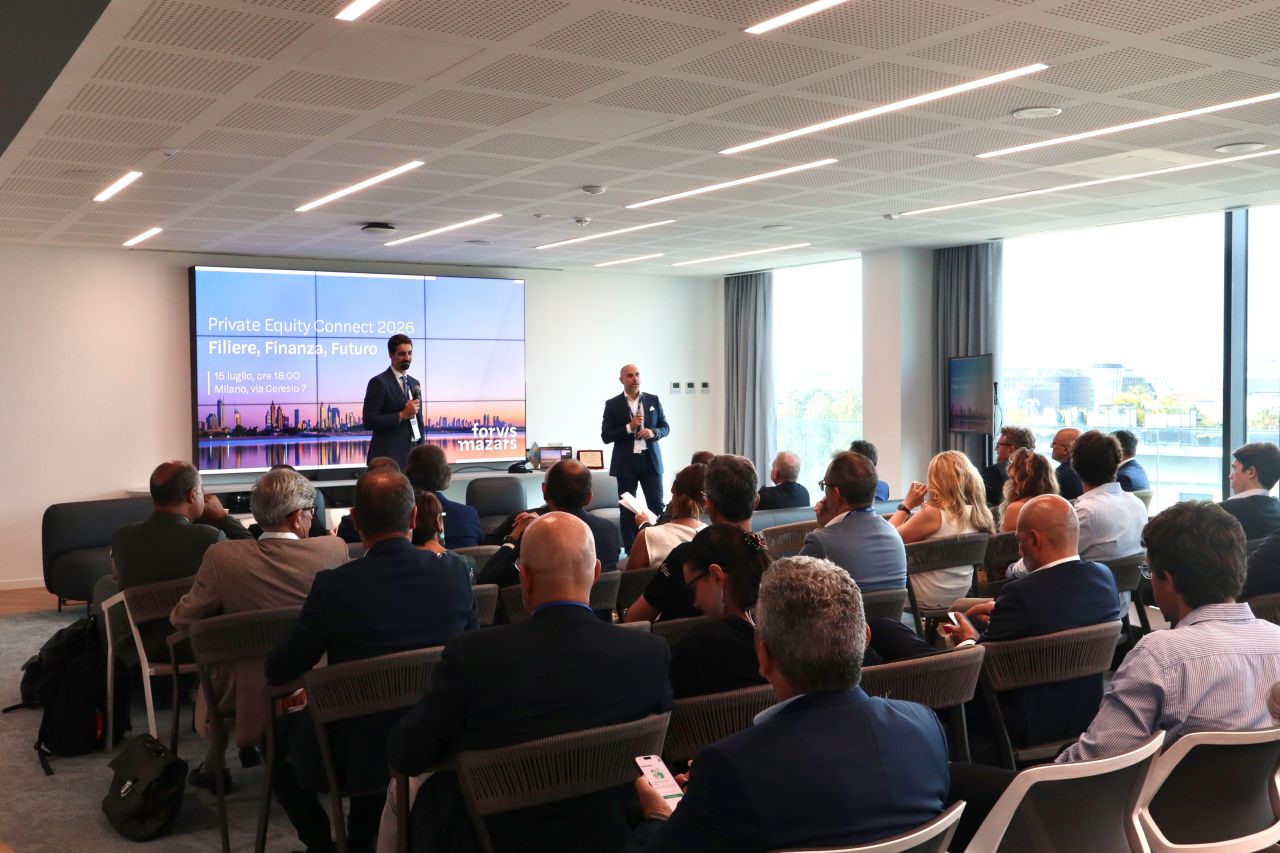
Quido is a Partner of the second edition of Private Equity Connect 2026 — Filiere, Finanza, Futuro, the event Forvis Mazars brings to Italy. It takes place in Milan on 15 July.
One room, more than a hundred of the leading private equity funds and operators from Italy and across Europe. This edition centres on the role of patient capital in supporting productive supply chains, and on the tie between small and mid-sized companies and the finance that backs their growth.
The evening opens with a keynote by Prof. Alessandro Pozzi on geopolitics and its impact on private equity. Two panels follow, moderated by Andrea Cabrini, a journalist at Class CNBC. At the Quido x Forvis Mazars stand, Quido presents its technological approach to private capital. A networking cocktail closes the evening.
This year Quido takes part as a Partner: a chance to meet the professionals who work on private equity and M&A deals every day, the audience the platform is built for.
The event begins at 6:00 pm on 15 July, in Milan, at via Ceresio 7, in the Forvis Mazars offices. Attendance is by invitation and places are limited.
The evening, in order
The structure is designed so that content and conversation do not get in each other's way: first you listen, then it gets debated, then you talk.
Keynote. Prof. Alessandro Pozzi opens with a talk on geopolitics and its impact on private equity. It is the right register to start on: a framing that comes before the operational questions rather than after them.
Two panels. Two round tables follow, moderated by Andrea Cabrini, a journalist at Class CNBC.
Quido x Forvis Mazars stand. At the stand, Quido presents its technological approach to private capital. It is where the questions get concrete and the conversation moves from the general to the specific case of whoever is asking.
Networking cocktail. The evening closes with the part many attendees honestly travel for: the conversations that happen standing up, glass in hand, between people who have just heard the same things. Having a shared reference from minutes earlier is what separates a useful conversation from an exchange of business cards.
This edition's theme: supply chains, patient capital, SMEs
"Filiere, Finanza, Futuro" is not a generic title. It marks out a specific perimeter, and it is worth reading for what it says.
The edition centres on the role of patient capital in supporting productive supply chains, and on the tie between small and mid-sized companies and the finance that backs their growth.
"Patient capital" describes capital whose horizon is not quarterly: it enters a company to accompany a path rather than to pass through it. Private equity has always claimed that definition, and in a supply-chain context it takes on a further meaning — because the value of a business inside a chain is not read from its accounts alone, but also from the position it holds relative to those upstream and downstream of it.
The supply chain is the second term that shapes the discussion. Looking at a company as a node in a chain rather than as an isolated entity changes the questions an investor asks: who the significant customers and suppliers are, how concentrated the dependency is, what transactions have taken place upstream and downstream, who else in the segment has already received capital.
The SME is the third. It is the fabric Italian private capital works on, and it is also the segment where information is hardest to assemble — a point we return to below, because it is where Quido's work meets that of the people in the room.
Why geopolitics opens the evening
The running order says something. The evening starts with a keynote on geopolitics and its impact on private equity, and only then moves to operational themes.
That is consistent with the edition's theme. Productive supply chains are exactly the level at which geopolitical decisions turn into industrial consequences: where a business sources from, how long and how concentrated its supply chain is, which segments become strategic and which move. Within a few years these variables have stopped being background and become an input to valuation.
For an investor the consequence is concrete: the same company, with the same accounts, can be worth different amounts depending on whether it sits in an exposed or a protected chain. That reading is not done on the accounts — it is done by placing the accounts in a context — which is why opening there, before the panels, makes sense.
The speaker is Prof. Alessandro Pozzi. The two panels that follow are moderated by Andrea Cabrini, a journalist at Class CNBC.
Why Quido takes part as a Partner
This year Quido takes part as a Partner. The reason is direct: the room holds the audience the platform is built for — the professionals who work on private equity and M&A deals every day.
For a company building tools for a specific profession, distance from users is the main risk. An event with this composition is one of the few settings where that distance genuinely narrows: not through a survey, but by talking to the people who do the work, while they are discussing it with their peers.
There is a simpler reason too. The best conversations about a tool do not start from the tool: they start from a problem at work. A stand inside an evening about supply chains and SMEs produces different — and better — questions than a stand inside a technology fair.
Who is in the room, and why the composition matters
More than a hundred of the leading private equity funds and operators from Italy and across Europe. The number alone says little; the composition says a lot.
An event bringing European operators alongside Italian ones puts two perspectives in the same room that normally meet only inside a transaction: those who look at the Italian market from within, with granular knowledge of its territories and supply chains, and those who look at it as one market within a broader portfolio.
The second perspective brings the question that most often lacks a quick answer: how, in a market made up predominantly of private companies, do you arrive at a picture comparable to the one available elsewhere. Much of the interest in analytical tools starts there, and it is why a stand in this room fields different questions from one anywhere else.
What Quido presents at the stand
At the Quido x Forvis Mazars stand, Quido presents its technological approach to private capital. In concrete terms, the platform covers these areas:
- Multi-criteria search across millions of Italian companies by sector, size, geography and financial signals.
- Company profile with reclassified accounts, KPIs, peer comparison, news and corporate structure.
- AI agent reasoning over the platform's data and returning sector analysis, target shortlists or summary memos, with sources.
- Shared deal flow, with custom stages, filters, ownership and follow-ups.
- Automated reports — one-pagers, reclassified accounts and memos — in the firm's format.
- Quido MCP, which brings the same data into compatible AI assistants read-only, and the mobile app for iOS and Android.
Anyone wanting to arrive prepared can read the two articles on those last two in advance: Quido MCP and the mobile app.
Where the evening's theme meets the work on data
There is a technical reason why an evening about supply chains and SMEs is the right setting for a conversation about data.
Analysing a supply chain means relating different companies to one another. Knowing one business well is not enough: you need to know who sits around it, who controls it, which investors have already backed the segment, what transactions have happened in recent years and which individuals recur in the relevant roles.
On listed companies that exercise is laborious but linear, because the information arrives already normalised. On private SMEs it is a different craft. The starting point is filed accounts and registry information: public, verifiable material, but produced to discharge an obligation rather than to be compared with that of another two hundred companies.
From this follow the manual steps familiar to anyone who has screened SMEs: mapping line items onto a common scheme, checking that the formal classification matches the real sector, unpicking ownership chains one level at a time, linking individuals to the companies where they hold roles.
That is the work Quido sets out to absorb. The platform reclassifies accounts, reconstructs ownership, links people profiles to the deals they took part in and keeps the profile current, with every item traceable to its source. What remains with the analyst is the part that takes judgement: reading the chain, working out where the value sits, deciding.
What changes, concretely, when supply chain analysis is fast
It is worth translating this into a piece of work, because that is how the question presents itself to whoever lives it.
A fund is looking at a mid-sized manufacturer. The immediate question concerns its accounts, but the questions that decide the transaction concern context: how many other operators with similar characteristics exist in the same segment, what position the company holds relative to those upstream, which businesses in the chain have already taken institutional capital, who sits in the relevant roles and where else they appear.
Without tools, each of these questions opens a small worksite: lists to build, accounts to retrieve and reclassify, ownership chains to unpick, directorships to cross-reference. The cost is not per answer — it is that the answers are needed together and quickly, because a transaction has a window.
The practical effect of compressing that work is not only saving hours. It is that certain questions get asked at all: the ones that, at half a day each, end up skipped. The difference between a complete diligence and an adequate one almost always sits there, rather than in the quality of the person running it.
The tie between SMEs and finance, which is not a slogan
The theme's second axis — the tie between SMEs and the finance that backs their growth — describes a relationship that in practice is more complicated than it sounds.
From the company's side, the arrival of an institutional investor is rarely a purely financial decision. It touches governance, the move from family management to a structure with reporting obligations, the definition of a path and a horizon. These are changes negotiated before the transaction and lived after it.
From the investor's side, the same relationship appears as a knowledge problem. Assessing a private company means working from disclosure designed to satisfy an obligation, not to persuade a market. Much of what matters — the quality of customer relationships, the strength of the management team, dependence on a few individuals — appears in no filed document and has to be reconstructed.
Between those two sides sit the intermediaries: advisers, accountants, banks, professionals who have known the business for years. It is why a substantial share of Italian deal flow comes from relationships rather than from announcements.
And it is also why an evening like this is not an accessory to the profession: it is the setting in which those relationships are maintained.
Why an invitation-only event has a different density
Attendance is by invitation and places are limited. That is not a courtesy formula: it changes the nature of the evening.
In an open room, much of the conversation goes into working out who you are talking to. In a selected room that step is already settled, and conversations start from substance. It is the difference between explaining what your fund does and discussing a specific segment with somebody who has already looked at it.
There is an effect on the kind of questions a stand receives, too. In a generalist setting the questions are about what; among operators they are about how and how much — at what depth of data, over what perimeter, with what traceability, in what time. Those are the questions that make attendance worthwhile, because they are the ones that steer the work.
The questions that usually come up at the stand
An event like this produces recurring questions. The answers are the ones published on the site, and it is useful to set them out in advance.
Where does the data come from? From Italian public sources — the Chamber of Commerce and filed accounts — and from proprietary data kept up to date in real time. Every item remains traceable to its source.
Is the firm's data secure? European infrastructure, data encrypted at rest and in transit, GDPR compliance. Client data is not used to train models.
How does it fit with what we already use? With CRMs, deal flow systems and the Office suite, with export to PDF, Word and Excel and a REST API for custom integrations.
What does it cost? The model is a fixed annual fee, with unlimited users across the firm and unlimited searches, analyses and reports. MCP, mobile and API access are included, as are onboarding, training and support. The price is set on the size of the team.
How long before we are up and running? A team is typically productive in under a week. Setup, training and support are included and require no dedicated internal project.
How to prepare well for an evening like this
A piece of practical advice, valid regardless of Quido, for anyone attending an event with this composition.
The useful time is shorter than it looks. Across keynote, panels and cocktail, the genuinely available conversations amount to a few dozen minutes, spread among people who meet once a year. Whoever arrives knowing who they want to meet, and why, gets far more out of it than whoever arrives to see how the wind is blowing.
The preparation needed is not long: knowing which companies and funds sit within your perimeter of interest, what they have done recently, and which question is worth asking. It is exactly the kind of preparation that takes half an hour when the material is already to hand, and does not get done at all when it means opening five different sources.
The reverse holds as well: after the event, the names collected are worth something only if somebody picks them up within a few days. That is where the difference between a good event and a wasted one is decided, and it does not depend on the event.
What this article is not
A few boundaries, to avoid over-reading.
It is not an invitation: attendance is by invitation and places are limited. This article describes Quido's presence at the event; it does not distribute access to it.
It is not the official programme: the elements reported — keynote, panels, stand, cocktail — are those communicated; the event is organised by Forvis Mazars.
It is not a product announcement: the capabilities mentioned are already available to client organisations, and this article announces no releases or previews.
It is not a position on the topics under discussion: patient capital, supply chains and the tie between SMEs and finance are the edition's theme, and this article frames them without attributing to Quido views that the speakers will debate.
Practical information
The event begins at 6:00 pm on 15 July, in Milan, at via Ceresio 7, in the Forvis Mazars offices. Attendance is by invitation and places are limited.
Frequently asked questions
When and where does Private Equity Connect 2026 take place?
On 15 July, at 6:00 pm, in Milan, at via Ceresio 7, in the Forvis Mazars offices.
Who organises the event?
It is the event Forvis Mazars brings to Italy; this is the second edition.
What is this edition's theme?
"Filiere, Finanza, Futuro": the role of patient capital in supporting productive supply chains, and the tie between SMEs and the finance that backs their growth.
Who attends?
More than a hundred of the leading private equity funds and operators from Italy and across Europe.
How do you get in?
Attendance is by invitation and places are limited.
What is Quido's role at the event?
Quido is a Partner of the second edition and is present with the Quido x Forvis Mazars stand, where it presents its technological approach to private capital.
What does Quido present at the stand?
Its technological approach to private capital: multi-criteria search across Italian companies, the company profile with reclassified accounts and peer comparison, the AI agent, shared deal flow, automated reports in the firm's format, plus Quido MCP and the mobile app.
Do you have to be a client to stop by the stand?
No. The stand is open to event attendees; access to the platform, by contrast, is restricted to client organisations.
What does Quido do?
Quido automates financial analysis for private equity, investment banking and advisory: company research, analysis, reporting and up-to-date data in a single platform, with every item traceable to its source.
Is this the first time Quido attends the event?
This is the second edition of Private Equity Connect, and this year Quido takes part as a Partner.
Who speaks?
The evening opens with a keynote by Prof. Alessandro Pozzi on geopolitics and its impact on private equity, and continues with two panels moderated by Andrea Cabrini, a journalist at Class CNBC.
In summary
Quido is a Partner of the second edition of Private Equity Connect 2026 — Filiere, Finanza, Futuro, the event Forvis Mazars brings to Italy. It takes place at 6:00 pm on 15 July in Milan, at via Ceresio 7, with a keynote by Prof. Alessandro Pozzi, two panels moderated by Andrea Cabrini, the Quido x Forvis Mazars stand and a networking cocktail. Attendance is by invitation and places are limited.
To read up on the product beforehand: Quido MCP and the mobile app for iOS and Android. Background on the company is in the article on the €1.6 million funding round, and questions on sources, security, pricing and integrations are answered on the FAQ page.