Company
Company
Quido takes its pitch to San Francisco
Explaining Italian private capital to an audience that looks at it from the outside.
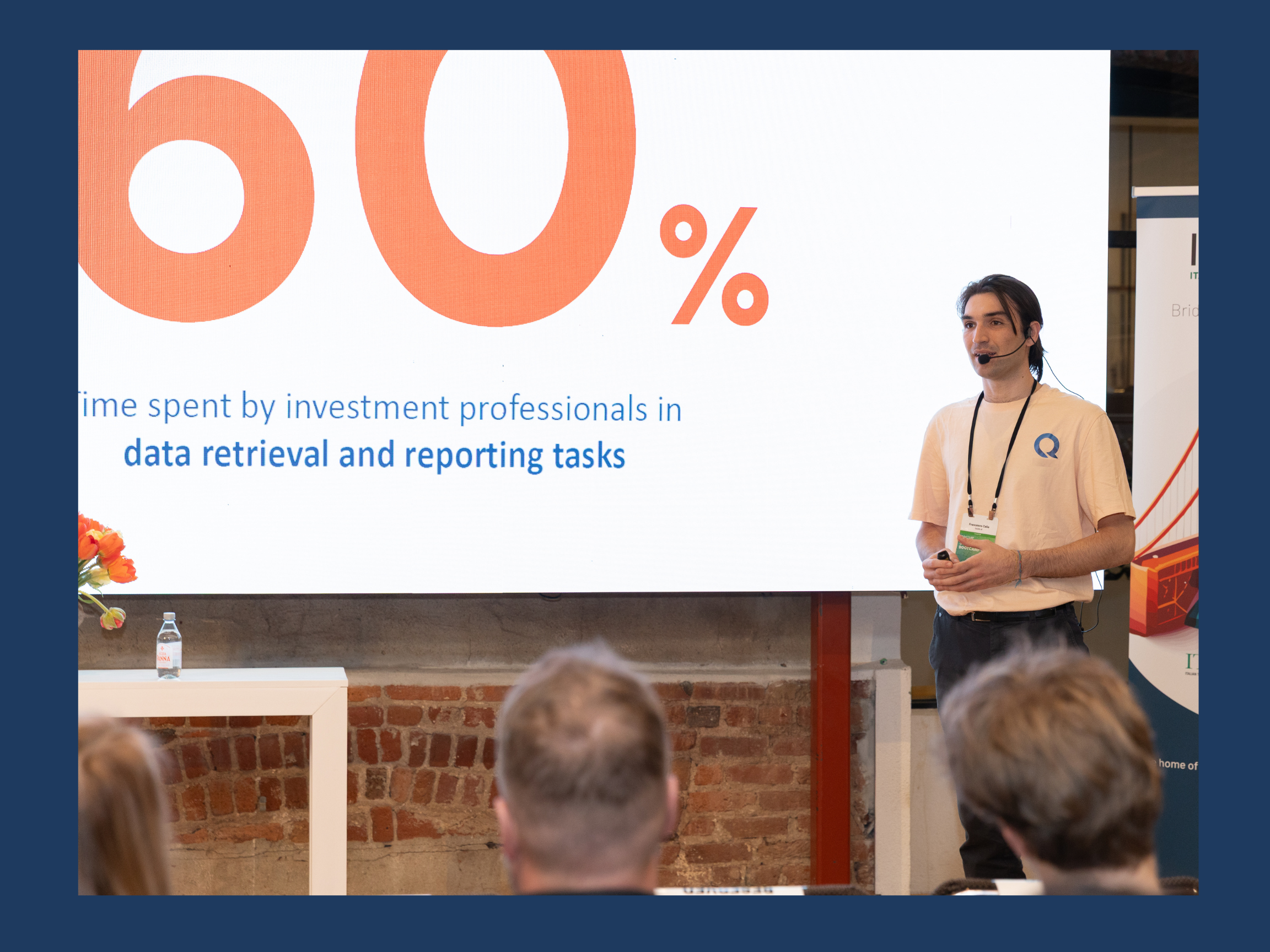
Quido presented its work in San Francisco, to an audience of investors and technology operators.
Quido automates financial analysis for private equity, investment banking and advisory: company research, analysis, reporting and up-to-date data in a single platform, with every item traceable to its source.
Why take an Italian vertical product to California
The question is a fair one, and it is usually the first one asked in the room: what is the point of presenting a tool built on the Italian market in San Francisco.
The answer has two parts.
The first concerns capital and expertise. The Bay Area concentrates a number of investors specialising in software applied to a single industry that no other place matches. These are people who have seen the same pattern dozens of times — a professional market with manual processes, a data source that is hard to normalise, a product that slots into an existing workflow — and who therefore get to the point far faster. Presenting to an audience that already knows the category means skipping the introduction and going straight to what matters.
The second concerns testing the story. A vertical product is easy to explain to people inside the vertical: a few sentences will do, because the problem is shared. Explaining it to people who do not practise that profession is a different and far harsher exercise. If the value does not hold once the implicit context is removed, it does not hold inside the context either — it is simply that nobody notices.
There is a third, less elevated and more practical reason. The way software gets built moves quickly, and distance from the user is not the only distance that matters: distance from people solving adjacent problems elsewhere matters too. Spending a few days inside that flow of conversations is a form of updating that is hard to get from reading.
What Quido says when it introduces itself
The pitch starts from an observation about the profession, not from a feature.
People working on private equity, M&A and advisory deals spend a significant share of their time on activities that contain no judgement: finding the company, retrieving filed accounts, reclassifying them, reconstructing ownership, lining up the news, laying it all out in a readable document. This work is necessary, it demands care, and it is entirely different from the work those people were hired for, which is interpretation: judging whether the margin holds, whether the comparison with peers stands up, whether it is worth proceeding.
Quido works on the first part and leaves the second untouched. The company's stated mission is to free analysts and partners from repetitive work and return time to where it creates value. Repetitive work can be automated; judgement cannot.
From that follows what the platform does today:
- Multi-criteria search across millions of Italian companies by sector, size, geography and financial signals, with filters and results ranked by relevance.
- Company profile with reclassified accounts, KPIs, peer comparison, news and corporate structure, generated automatically and kept up to date.
- AI agent reasoning over the platform's data: ask for a sector analysis, a target shortlist or a summary memo, and the answer comes back structured and sourced.
- Shared deal flow: the team's transactions on a single board, with custom stages, filters, ownership and follow-ups.
- Automated reports — one-pagers, reclassified accounts and memos — generated in the firm's format and ready to share.
The starting problem: data on private companies
There is one part of the story that always takes longer than expected in front of an international audience, and it is also the part that explains why the product exists.
Analysing a listed company and analysing a private one are two different crafts. For a listed company, information is normalised at source: the company reports on a known calendar in a predictable format, and a chain of providers redistributes it already comparable. For a private company the starting point is the filed accounts, together with registry information. The data exists, it is public and it is verifiable — but it is not produced in order to be compared with that of another two hundred companies.
The practical consequences are familiar to anyone who has screened SMEs. Line items have to be mapped onto a common scheme before they can be set side by side. The formal sector classification often does not match the sector the company actually operates in. Ownership can run through intermediate holdings that have to be unpicked one level at a time. Relevant individuals appear in roles across different companies, and connecting them means working through several filings.
None of these steps is intellectually difficult. All of them are expensive in time and all of them are repetitive — the exact definition of work that software can absorb. It is also why a product like this cannot be built generically: knowing how that data behaves, in that country, is as much a part of the product as the code.
What changes when the audience does not know the market
Presenting outside your own market forces you to dismantle a few argumentative shortcuts. They are worth listing, because they are the same ones anyone trips over when explaining a vertical to people who do not live inside it.
"Everyone knows this work is manual." Outside the sector nobody knows, and the most common reaction is surprise that it still is. The story therefore has to start from the real process, step by step, rather than from its summary.
"The data is hard to get hold of." Put that way it is ambiguous, and it is heard as "the data does not exist". The data does exist, it is public and largely free: what is missing is its shape. The distinction between availability and comparability is the heart of the problem, and it has to be spelled out.
"It is a small market." Any national market is, compared with the addressable market of a horizontal product. The useful conversation is not about size in the abstract but about structure: how concentrated demand is, how deep usage goes per client, what it costs to serve.
"AI will solve all of this anyway." This is the most frequent observation in a technology setting, and it leads to the most interesting part of the discussion.
General AI and proprietary data: where the line runs
A general AI assistant, asked about an Italian SME, has three structural limits.
The first is coverage: the information published about a mid-sized private company is sparse and discontinuous. The second is currency: a model reflects the material it was trained on, and recently filed accounts do not enter that knowledge merely by having been filed. The third, and the most treacherous, is provenance: even when the answer is correct, there is no way to trace it to a verifiable source — and in an investment committee a figure without provenance cannot be used, however plausible it looks.
The consequence is that the value does not sit in the model, which is a technology available to anyone: it sits in the normalised, traceable data the model is connected to, and in the workflow the answer lands in.
A working criterion follows from that. The useful question is not how capable the model is, but what it is connected to and where its answer lands: a model connected to normalised, traceable data produces material that can be used in diligence, while the same model connected to nothing produces plausible text nobody can defend in committee.
It is a distinction that takes some patience to defend in a technology setting, because the spectacular part is the model and the part that determines the outcome is the data.
The commercial model, and why it is a choice rather than a detail
Quido is sold on a fixed annual fee, with unlimited users across the firm and unlimited searches, analyses and reports. Onboarding, training and support are included.
This needs explaining, because the prevailing model in the category is different: per-seat licences and credit packs consumed with every search.
The problem with consumption pricing is not the price: it is the effect on behaviour. When every search carries a visible marginal cost, teams stop searching. An analyst who knows each additional look consumes a credit takes fewer of them, and the tool ends up used below its capacity precisely in the phases — origination and screening — where it would help most. Per-seat licensing produces the same effect along a different dimension: it discourages extending the tool to people who would use it occasionally, which is exactly the group that benefits from occasional access to data already held in house.
A fixed fee removes the mental arithmetic. It costs something in predictability of revenue per client and returns depth of usage — and in a vertical, depth of usage is what determines whether the product stays.
What a vertical market teaches you about building product
Part of the exchange in settings like this is not about the company but about how to work. Some recurring observations.
Distance from the user is the main risk. In a horizontal product you can be wrong for a long time without noticing, because the audience is varied and somebody will use it anyway. In a vertical you cannot: if a feature does not solve a real problem, the twenty professionals who would have used it notice immediately and stop.
Traceability is not a feature, it is a precondition. Where the output ends up in a document discussed by a committee, a figure that cannot be traced to a source is not an acceptable approximation: it is unusable material. That changes technical priorities profoundly, and it changes them from day one.
The format of the output matters as much as its content. A tool producing excellent analysis which then has to be retyped into the firm's template moves the work rather than removing it. It looks like a secondary detail and it decides whether the product gets adopted.
Integration with the existing stack is not negotiable. Quido connects to CRMs, deal flow systems and the Office suite, exports to PDF, Word and Excel, and offers a REST API. No adoption goes through abandoning the tools a firm's habits are built around, the spreadsheet included.
The recurring questions from an investor audience
People assessing a company ask different questions from people assessing a tool. The recurring ones are few.
What stops a competitor from doing the same thing? The honest answer is not the model: it is the accumulated work on the data — normalisation, reconciling sources, unpicking ownership chains — and the knowledge of how that data behaves in edge cases. It is slow, unspectacular work, and hard to skip.
Why now? Because the availability of models capable of reading and summarising has moved the bottleneck. While summarising was manual, normalised data was worth less; now that summarising can be automated, normalised data is the limiting factor.
Is the product defensible outside its home market? It is the right question and it has no short answer: the part of the product concerned with workflow is general, the part concerned with data is jurisdiction-specific. How much weight each carries is exactly what should be discussed rather than asserted.
Who uses it today, and how? This is the question answered best, because it requires no forecasting: Italian funds, banks and advisers use it for screening, due diligence and reporting. It is also the question that brings the conversation back to verifiable ground after the previous ones have pushed it towards the future.
How to prepare a story for people who do not know the market
If anything here transfers, it is the method for building the explanation. It holds for a pitch to an investor, for a presentation to a client in another sector, and ultimately for an internal conversation with somebody who has just joined.
Start from the process, not the product. The sequence that works is: here is what a person does today, step by step; here is how long it takes; here is which of those steps contains a decision. Only then say what the tool does. Reversing the order produces a description of features nobody can place.
Separate the specific from the general. Two layers coexist in a vertical: one holds everywhere — running a pipeline of transactions, producing a shareable document — and one holds in a single jurisdiction, because it depends on how that country produces its public data. Confusing them makes the product look either more fragile or more general than it is. Both errors are costly.
Name the limits before your counterpart does. The hard questions arrive regardless; getting there first turns the conversation from an examination into a discussion. It is also the only way to surface the real objections, the ones that otherwise stay unsaid.
Do not promise what has not been built. It is the simplest rule and the easiest to break when the room is interested. A product described by what it does today survives a second conversation; one described by what it will do does not.
Adoption: the cost line nobody budgets for
There is an aspect of the product that takes a couple of lines in a presentation and weighs heavily in a client's life: how much time passes between signature and the moment the team is genuinely working with the tool.
A team is typically productive in under a week, and setup, training and support are included. Put that way it sounds like an administrative note; in fact it describes a product decision. A short activation time is only possible if the tool does not require the client to bring their own data, clean it and load it: the data Quido works on is already in the platform, which is why the first day is already a useful day.
The other half of the same question is internal spread. With unlimited users across the firm, extending access to a colleague is not an economic decision: there is no licence to buy, so there is nobody to persuade. A tool spreads on usefulness only when nothing slows that spread for reasons unrelated to usefulness.
These are two unglamorous details, and they are among the few that reliably predict whether professional software gets used or abandoned.
What you take home
The most useful part of an exchange like this is rarely the part you anticipate before setting off.
It is not the compliments, which are easy to collect and teach nothing. Nor is it the generic objections, which are already familiar. It is the question asked by somebody who understood the product better than expected, and who then asks the thing that had not yet been answered internally.
Those questions are worth the trip, and they are also the only honest measure of how it went: not how many people nodded, but how many asked something that was still on the table on the way back.
What this article is not
The perimeter is worth stating, because a story like this is easily read as more than it says.
It is not the announcement of a funding round: this article communicates no round, investor or amount.
It is not the announcement of a US market entry: it describes an occasion for exchange, not a change of commercial perimeter.
It is not a product announcement: the capabilities mentioned are those already available to client organisations.
It is not a commitment on timing or on a roadmap.
Frequently asked questions
What does Quido do?
Quido automates financial analysis for private equity, investment banking and advisory: company research, analysis, reporting and up-to-date data in a single platform, with every item traceable to its source.
Where does the platform's data come from?
From Italian public sources — the Chamber of Commerce and filed accounts — and from proprietary data kept up to date in real time. Every item remains traceable to its source.
Is client data used to train models?
No. The infrastructure is European, data is encrypted at rest and in transit, processing is GDPR compliant, and client data does not feed model training.
How does pricing work?
On a fixed annual fee: unlimited users across the firm, unlimited searches, analyses and reports, alongside onboarding, training and support. The price is set on the size of the team.
How long does it take to get started?
A team is typically productive in under a week. Setup, training and support are included.
Does Quido integrate with the tools a firm already uses?
Yes: CRMs, deal flow systems and the Office suite, with export to PDF, Word and Excel and a REST API for custom integrations.
Is Quido opening a US office?
No. This article describes an occasion for exchange, not a change of commercial perimeter: the target market remains the one described above.
Does Quido's AI replace the analyst's work?
No. The platform absorbs the collection and normalisation part — finding the company, reclassifying accounts, reconstructing ownership, laying out the document — and leaves interpretation untouched, which is where the investment thesis is built.
Why does traceability of the data matter so much?
Because the material the platform produces ends up in documents discussed by an investment committee. A figure that cannot be traced to a source is not an acceptable approximation: it is unusable material, and it forces somebody to redo the check by hand.
Who can access the platform?
Access is restricted to client organisations. Anyone wishing to evaluate it can request a demo from the site.
In summary
Quido took the story of its work to San Francisco: a product built on Italian private capital, on an information estate — private companies — that exists but is not born comparable, and on a commercial model that chooses depth of usage over metered consumption.
Anyone wanting to know the people behind the product will find them on the About page. Questions on sources, security, pricing and integrations are answered on the FAQ page.